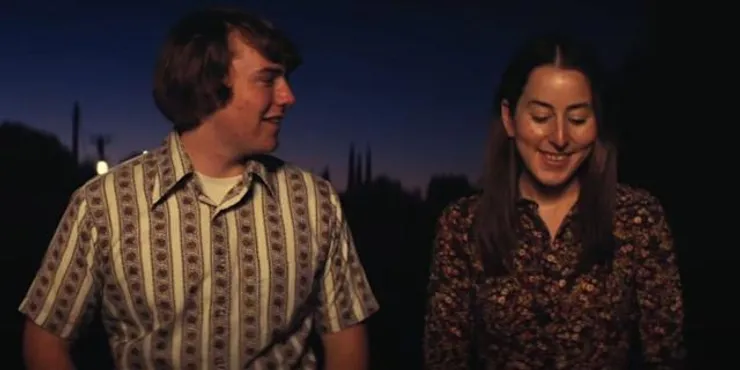


Elsinore (Reino Unido, Itália, 2026)
Título Original: Elsinore
Direção: Simon Stone
Roteiro: Stephen Beresford
Elenco principal: Andrew Scott, Olivia Colman, Billie Piper, Johnny Flynn, Joe Locke, Peter Mullan e Charles Edwards
Duração: 111 minutos (1h 51min)
Quando pensamos em Carruagem de Fogo (1981), muito possivelmente a primeira memória é relacionada à sua conhecida e muito reproduzida trilha sonora composta por Vangelis. No entanto, a história de seu ator principal, Ian Charleson, é uma daquelas que ficou engavetada nas memórias do cinema. Agora, em um momento de redescoberta, Elsinore vem trazer a sua vida após o filme, quando o ator já estava convivendo com a AIDS e tem uma oportunidade de uma vida ao ser escalado para atuar em Hamlet no Teatro Nacional britânico.
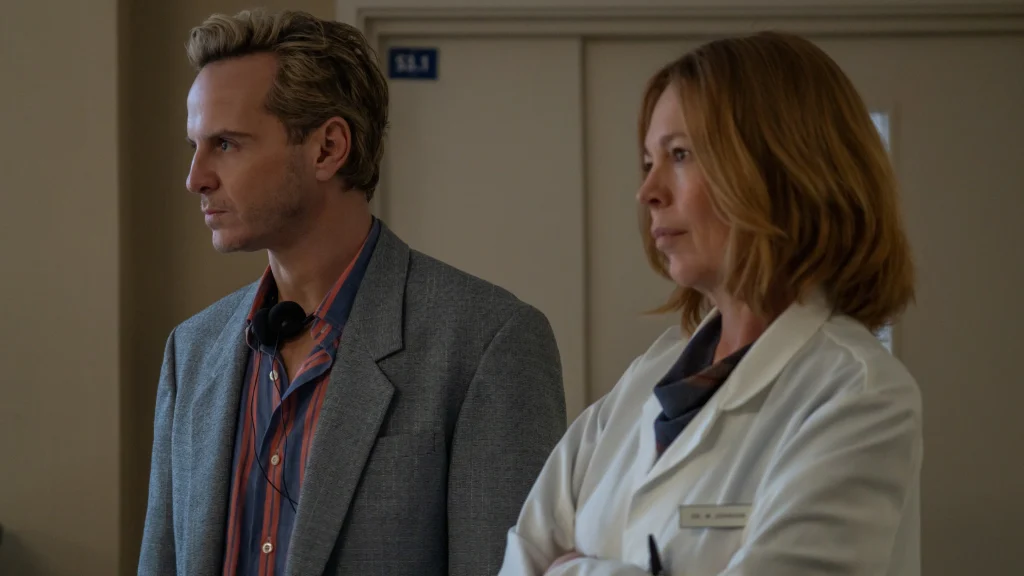
O filme lida com o dia-a-dia do ator, interpretado por Andrew Scott, enquanto ele navega por questões como a perda de amigos e o segredo sobre a sua própria sexualidade em um momento no qual a homossexualidade era tratada como um crime moral. A performance de Scott como o ator é um dos pontos mais impactantes do filme, com uma grande entrega ao universo interno desse personagem e uma compreensão profunda sobre as suas angústias naquele momento. Mais do que isso, ele consegue mimetizar o embate entre a sua perda de força física por conta do adoecimento com a sua profunda força mental, lutando todos os dias para poder permanecer fazendo aquilo que amava até o último momento. Mesmo para quem entra na sala de cinema sabendo nada ou quase nada sobre Charleson, tanto pela criação do personagem pela narrativa quanto pela interpretação sensível de Scott, é muito difícil não acabar se emocionando com os acontecimentos.
A obra também consegue trazer consigo muito do clima social e político daquele final dos anos 1980, com a marginalização dos LGBTQ+ e a insegurança que as próprias pessoas soropositivas tinham em relação aos próximos passos de sua vida. A representação a partir da Dra. Margaret Johnson (Olivia Colman) das pessoas aliadas, mesmo naquela época, também é bastante significativa e ajuda a reafirmar a fé na humanidade, mesmo em meio ao clima triste.
Por mais que a obra conte com uma história real comovente e com um elenco que excede as expectativas, sente-se uma mão muito pesada da direção em relação a tornar esse clima ainda mais épico e pesado, e além de parecer uma tentativa forçada de colocar o filme no radar das grandes premiações, também faz com que as cenas mais dramáticas percam o impacto pelos excessos. A trilha sonora, por exemplo, é um elemento que gera muito incômodo pela sua presença marcante a todo momento e, nas cenas finais, por parecer mais alta que o volume do próprio filme, instigando o espectador a chorar. A montagem também funciona neste sentido, com algumas cenas parecendo ser picotadas para funcionar bem na tela e aumentar o seu impacto emocional, mas causando uma disrupção incômoda que impede quem assiste até mesmo de se concentrar.
Assim, por mais que o longa funcione como um resgate à essa figura histórica que inclusive poucos sabiam ser LGBTQ+, ele cai em armadilhas de superproduções que fazem com que uma história inspiradora caia em diversos clichês.
Elsinore (UK, Italy, 2026)
Original Title: Elsinore
Director: Simon Stone
Writer: Stephen Beresford
Cast: Andrew Scott, Olivia Colman, Billie Piper, Johnny Flynn, Joe Locke, Peter Mullan, and Charles Edwards
Runtime: 111 minutes (1h 51min)
When we think of Chariots of Fire (1981), the first memory that likely comes to mind is its famous, widely played soundtrack composed by Vangelis. However, the story of its lead actor, Ian Charleson, is one that has largely faded from cinematic memory. Now, in a moment of rediscovery, Elsinore brings to light his life after the film — a time when the actor was already living with AIDS and received the opportunity of a lifetime: being cast as Hamlet at the British National Theatre.
The film follows the daily life of the actor, played by Andrew Scott, as he navigates challenges such as the loss of friends and the need to keep his sexuality secret during an era when homosexuality was treated as a moral crime. Scott’s performance is one of the film’s most powerful elements; he fully immerses himself in the character’s inner world and demonstrates a profound understanding of the anguish he faced at the time. Moreover, he captures the conflict between his physical decline due to illness and his immense mental strength, showing his daily struggle to keep doing what he loved right up to the very end.
Even for viewers who enter the theater knowing little to nothing about Charleson, the combination of the narrative’s characterization and Scott’s sensitive performance makes it nearly impossible not to be deeply moved by the events on screen. The film also successfully captures much of the social and political atmosphere of the late 1980s, including the marginalization of the LGBTQ+ community and the uncertainty HIV-positive individuals faced regarding their futures. The portrayal of allies — embodied by Dr. Margaret Johnson (Olivia Colman) — is also highly significant; even for that era, it helps restore faith in humanity amidst the somber tone.
While the film features a moving true story and a cast that exceeds expectations, the direction feels heavy-handed in its attempt to make the atmosphere feel epic and weighty. Beyond appearing as a forced bid for major awards, this excess diminishes the impact of the most dramatic scenes. The soundtrack, for instance, is distracting due to its constant, overpowering presence; in the final scenes, the music seems louder than the dialogue itself, seemingly trying to coerce the viewer into tears. The editing follows a similar pattern, with scenes that appear chopped up to maximize emotional impact but instead create a jarring disruption that makes it difficult for the audience to even focus.
Ultimately, while the film succeeds in bringing attention to a historical figure — whose LGBTQ+ identity was known to few — it falls into the traps of big-budget productions, causing an inspiring story to succumb to various clichés.