
Promised Spaces (Sérvia, França, Camboja e Alemanha, 2026)
Título Original: Promised Spaces
Direção: Ivan Marković
Roteiro: Ivan Marković
Elenco principal: Vollak Kong, Chea Loch, Vita Vong, Lyer Von, Theara Or, Kanitha Tith
Duração: 76 minutos
Apesar de se passar no interior do Camboja, Promised Spaces é um filme estranhamente universal. Acompanhamos praticamente duas histórias que acontecem de forma paralela, cruzando-se apenas tematicamente e através da ocupação de um mesmo espaço que é indefinido em tela. Não há uma linha de diálogo ou uma placa que indique sua localização, sendo necessário pensar na sua produção e língua até para se situar geograficamente no mundo.
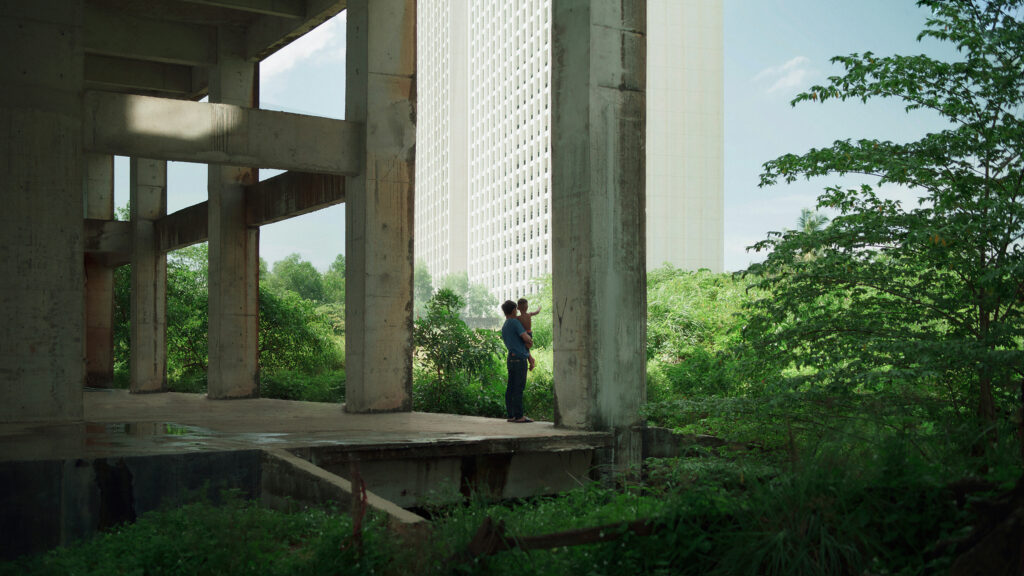
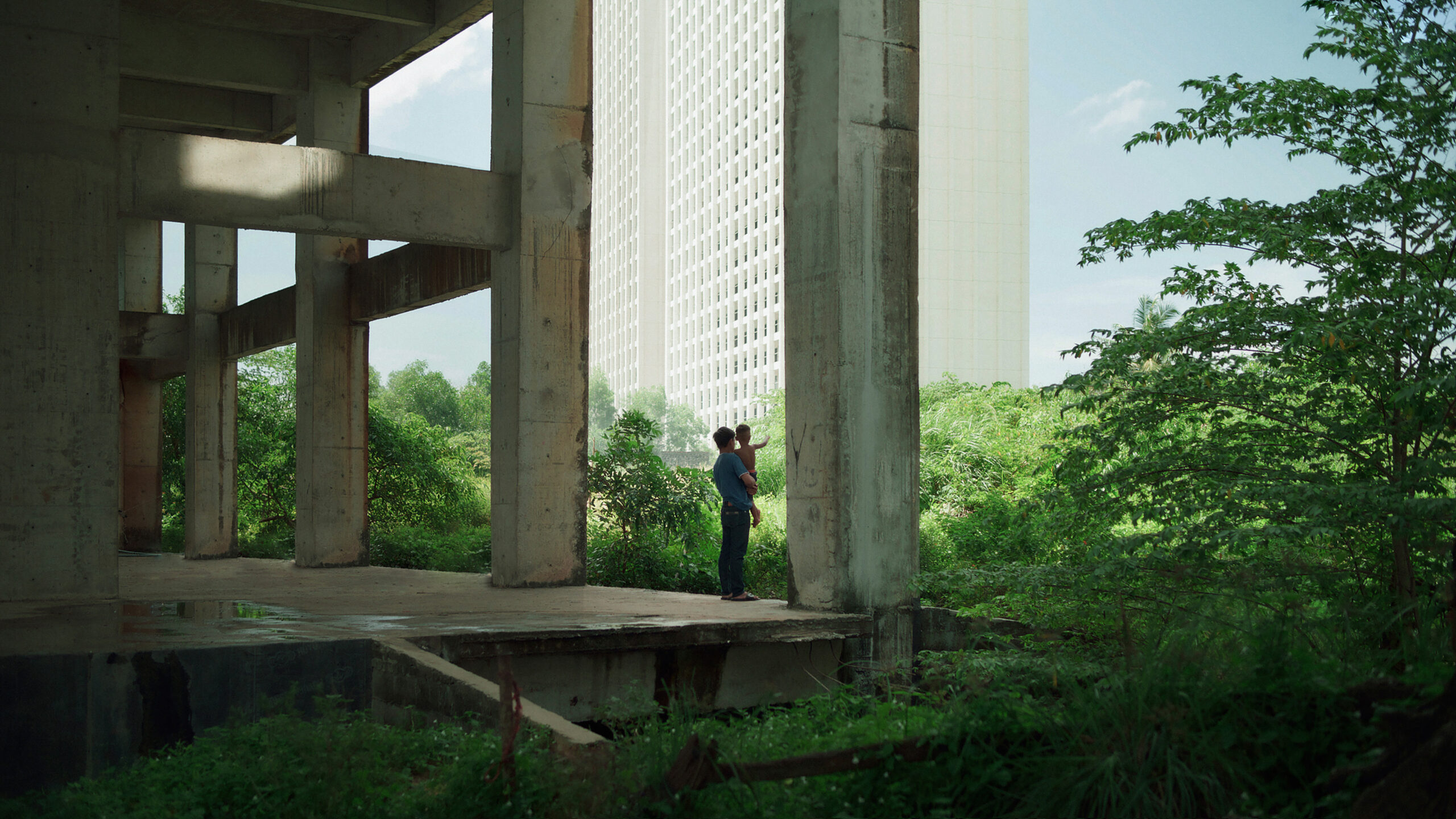
Começamos com cenas que contrastam bastante a figura humana com as grandes construções que parecem praticamente abandonadas, lidando com dois lados de uma mesma moeda. De um deles, Sokun é um trabalhador que vive em um alojamento superlotado e em um determinado momento saiu de lá para viver em um arranha-céus abandonado. Seda, que ocupa a outra metade do filme, é uma moradora que chega a um condomínio residencial de luxo e acaba se sentindo excessivamente isolada ali dentro. Por mais que o país tenha uma formação geopolítica específica, que atraiu o capital investidor chinês para a construção desses grandes prédios sem pensar na real demanda por eles, algo do gênero em maior ou menor escala acontece praticamente em todas as grandes cidades do mundo.
Ivan Marković é arquiteto de formação e isso transparece em seu filme. Principalmente através da fotografia, que ele também assina junto a Katharina Hauke, a escala entre os edifícios enormes e os pequenos humanos se torna contrastante. Ele faz questão da inclusão de muitos planos extremamente abertos justamente para reforçar essa noção, falando tanto sobre a ambição desses grandes projetos, da capacidade humana de realizar tamanhas obras e ainda sobre esses processos arquitetônicos que ignoram os seus arredores apenas pensando nas escalas. Em um determinado momento, quando começa a chover, percebemos o mesmo tipo de estrago que acontece em diversas cidades brasileiras quando chove, com a água seguindo algum curso natural que foi apagado pela urbanização e causando enchentes. Assim, nessa tríade entre sentimentos humanos, arquitetura e forças naturais, há uma crítica insistente nesse projeto de governo.
Tudo isso é feito com um mínimo de diálogo, que é substituído ou pelo silêncio ou por cenas nas quais personagens falam, mas não se escutam. Novamente, pensando na modernidade, nos processos capitalistas que estão à beira de um colapso e em uma falta de conexão com as pessoas ao seu redor, compreende-se que a radicalidade formal que fica clara desde o primeiro instante é relacionada a um radicalismo temático. Talvez por ser um filme no qual o diretor também tem um grande acúmulo de funções, de vez em quando ele se mostra excessivamente enigmático para o público, que tenta encontrar pontos de contato com essa obra que se demonstra bastante fechada em si mesma. Ao mesmo tempo, justamente por ser uma temática extremamente pertinente, ocasionalmente encontra-se um equilíbrio entre a compreensão da forma e do conteúdo.
Seria difícil dizer que o filme é uma obra simples, cuja compreensão é imediata quando se termina de assisti-lo. De maneira inversamente proporcional, algumas das questões ali levantadas são tão existenciais que podem acompanhar o espectador por um longo tempo.
In English, translated by Renata Torres:
Promised Spaces (Serbia, France, Cambodia, and Germany, 2026)
Original Title: Promised Spaces
Director: Ivan Marković
Screenplay: Ivan Marković
Main Cast: Vollak Kong, Chea Loch, Vita Vong, Lyer Von, Theara Or, Kanitha Tith
Running Time: 76 minutes
Despite being set in rural Cambodia, Promised Spaces is a strangely universal film. We follow practically two parallel stories, intersecting only thematically and through the occupation of the same undefined space on screen. There is no line of dialogue or sign indicating its location, making it necessary to consider its production and language even to situate oneself geographically in the world.
We begin with scenes that starkly contrast the human figure with the large, seemingly abandoned constructions, dealing with two sides of the same coin. From one of them, Sokun is a worker who lives in overcrowded housing and at a certain point leaves to live in an abandoned skyscraper. Seda, who occupies the other half of the film, is a resident who arrives at a luxury residential complex and ends up feeling excessively isolated there. Although the country has a specific geopolitical formation that attracted Chinese investment capital to the construction of these large buildings without considering the real demand for them, something similar, on a larger or smaller scale, happens in practically every major city in the world.
Ivan Marković is an architect by training, and this is evident in his film. Primarily through the cinematography, which he also collaborates on with Katharina Hauke, the scale between the enormous buildings and the small human figures becomes starkly contrasting. He insists on including many extremely wide shots precisely to reinforce this notion, speaking both about the ambition of these large projects, the human capacity to carry out such works, and also about these architectural processes that ignore their surroundings, focusing only on scale. At a certain point, when it starts to rain, we perceive the same kind of damage that occurs in various Brazilian cities when it rains, with the water following some natural course that has been erased by urbanization and causing floods. Thus, in this triad between human feelings, architecture, and natural forces, there is a persistent critique of this government project.
All this is done with a minimum of dialogue, which is replaced either by silence or by scenes in which characters speak but do not listen to each other. Again, thinking about modernity, about capitalist processes that are on the verge of collapse, and about a lack of connection with the people around them, it is understood that the formal radicalism that is clear from the first moment is related to a thematic radicalism. Perhaps because it is a film in which the director also has a large accumulation of functions, from time to time he appears excessively enigmatic to the audience, who try to find points of contact with this work that proves to be quite closed in on itself. At the same time, precisely because it is an extremely pertinent theme, occasionally a balance is found between the understanding of form and content.
It would be difficult to say that the film is a simple work, whose understanding is immediate upon finishing watching it. Conversely, some of the issues raised are so existential that they may stay with the viewer for a long time.
Obrigada, Aline Guevara, pelo apoio! Se você quiser ver o seu nome nas próximas críticas, não esqueça que o financiamento coletivo segue aberto em https://www.kickante.com.br/financiamento-coletivo/ajude-o-no-sofa-com-gatos.